
Medieval Manuscript Facsimiles
for Book Collectors & Libraries
Explore over 1580 Facsimile Editions at the Best Prices
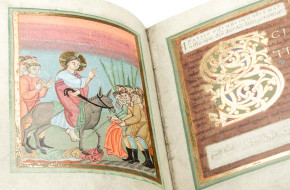
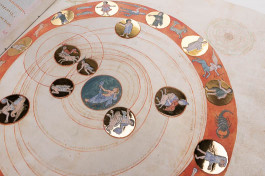

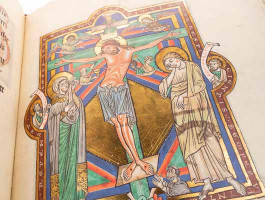
The World's Leading Libraries Trust Facsimile Finder





Experts in Facsimiles
We specialize in facsimiles, and we can help you source the editions you need: whether new from the publishers or pre-owned in mint condition, we'll find what you want at competitive prices.

Independent Supplier
We are not publishers, nor antiquarian bookseller.
We don't have a stock that we need to sell. We source the best for you, at the best price, in your best interest.
A Free Database
A fully searchable database, built for you to search the editions you need. Free, now and forever.

Librarian emerita
The Medieval Institute
University of Notre Dame
When I first met Giovanni I was impressed with his ability to partner with publishers to provide their usual full-size facsimiles at special prices for educational institutions. This approach would give universities access to teaching resources they could not otherwise afford. Over the years, Giovanni and his team have been true to their goal and offered a wide range of fine items... [ Read More ]

Publisher
Verlag Müller und Schindler & Faksimile Verlag
I remember when I met Giovanni at his first Frankfurt Book Fair - a young and very likeable guy who gained our trust from the very first moment. Through the years I have experienced a consistent, serious, engaged, and ambitious work on their part, showing a lot of passion for books and the medieval art. His positive attitude and professionalism are distinguishable, and so are his pizzas, some of the best I have ever tasted! ... [ Read more ]

private customer
England
It was a serendipity to discover this website and to get to know Giovanni. He has supplied me with some second-hand facsimiles in first-class condition for excellent prices, and it is always a special day when one of his packages arrives, always in perfect condition because of the careful packaging.Thanks to him I have been able to add some wonderful works to my collection... [ Read more ]

University in Utah
Login to view the full name
I use Facsimile Finder as a resource for students interested in conducting classroom based or independent research on manuscripts and early books [...] I also use the website as a resource for my own research and teaching activities – staying up-to-date on the latest releases helps me in my role as an occasional consultant for our library’s Special Collections development. ... [ Read more ]
Mentions from Twitter
Marco folks check out some lovely facsimiles from @FacsimileFinder at @UTKLibraries Special Collections #manuscripts @rsbevill pic.twitter.com/rR41tUqsaT
— Marco Institute (@marcoinstitute) February 9, 2017
Giovanni Scorcioni, co-founder of @FacsimileFinder shares his 10 most beautiful #manuscripts https://t.co/3blKBxcwON pic.twitter.com/WaKBRmDVDY
— Medievalists.net (@Medievalists) October 28, 2016

Blog on the History of Illuminated Manuscripts and their Facsimiles
-
 Fri, 10 Nov 2023
Highlights from the 75th Frankfurt Book Fair
-
 Thu, 03 Aug 2023
Three Bi-Lingual Illuminated Apocalypse Manuscripts
-
 Wed, 22 Feb 2023
Teaching with Hebrew Manuscript Facsimiles
-
10 Essential Details You Need to Know Before Purchasing a Facsimile Edition
A 30-page PDF files with insights on facsimiles
Download for Free -
 Tue, 21 Feb 2023
Manuscript Facsimiles as Teaching Tools
-
 Wed, 01 Feb 2023
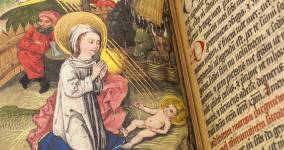
Learning about Making Manuscripts with a Cistercian Prayer Book
-
 Tue, 08 Nov 2022
What’s New at Frankfurt Book Fair 2022?
-
 Wed, 01 Jun 2022
How a Medieval Facsimile of a Roman Map Offered Direction in a Hybrid Classroom